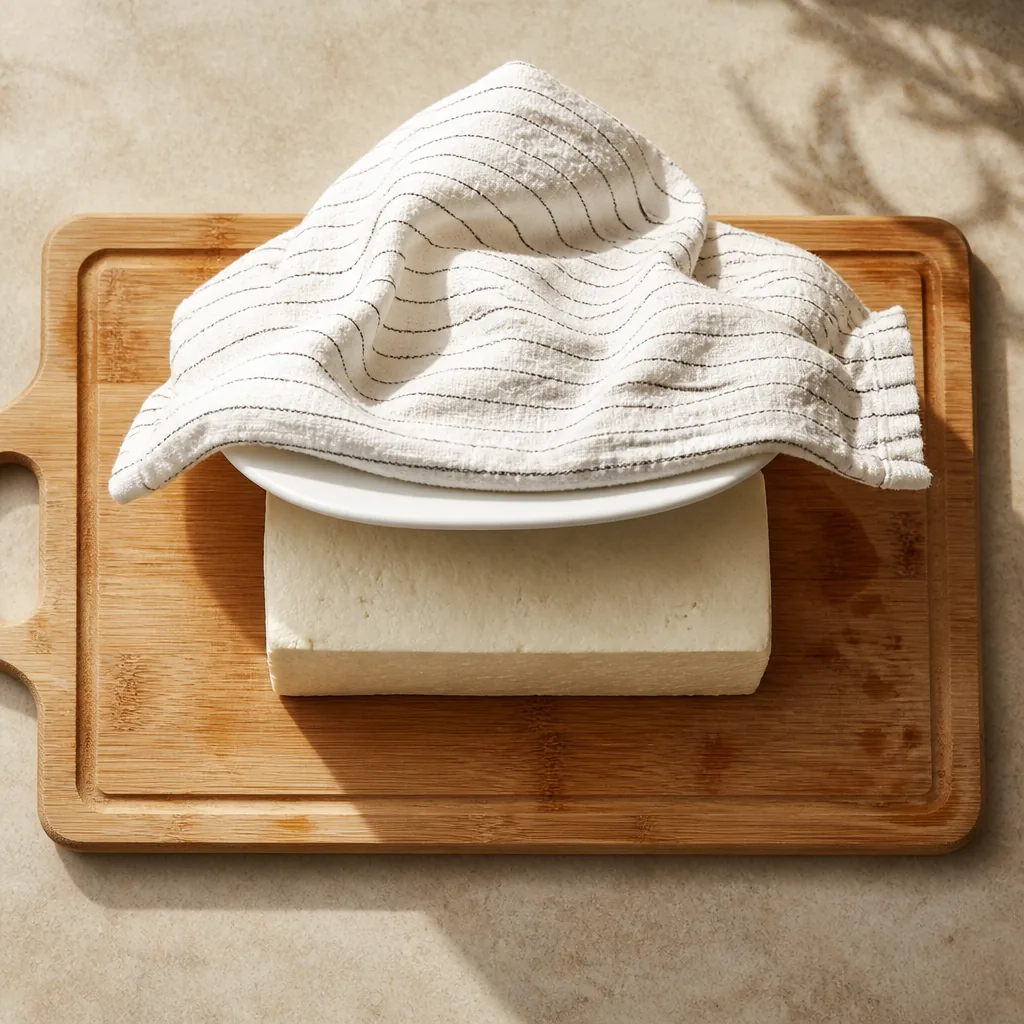
Open a block of firm tofu, tip out the packing liquid, and press your finger gently into the surface — water beads up right away. That is the whole problem in one moment. A standard block of firm tofu is somewhere around three-quarters water, and most of that water is doing you no favours. It dilutes any seasoning you add, it turns to steam the second the tofu hits a hot pan so the surface poaches grey instead of browning, and it keeps the whole block soft and shapeless when you want something that holds an edge. Pressing is the unglamorous first step almost every good tofu dish quietly depends on, and it takes far less effort than people expect. Squeeze even a portion of that water out and the same dull block firms up, browns properly, and finally starts to soak in the flavours you give it. Everything else in tofu cooking gets easier once this one thing is handled.
What pressing actually does
Think of firm tofu as a wet sponge. Left alone, it stays saturated, and a saturated sponge cannot take on anything new. Press some of the water out and you make room — for oil to crisp the surface, for marinade to soak in, for salt to reach past the outer millimetre. You also change the texture. A pressed block is denser and chewier, closer to the meaty bite people say tofu lacks. Unpressed tofu tends to crumble and slump; pressed tofu slices cleanly, holds a cube shape in a stir-fry, and stands up to being tossed around a hot pan without falling apart.
The other thing pressing fixes is browning. Browning needs a dry, hot surface. As long as the tofu is weeping water, that surface stays wet and cool, and you get pale, rubbery results no matter how long you cook it. Press it first and the outside dries out fast in the pan, so it can colour and crisp the way you actually want.
Which tofu to press
Press firm and extra-firm tofu. These are the blocks you fry, bake, grill, and cube into stir-fries, and they respond well to losing water. Extra-firm is the most forgiving if you are new to it. Do not press silken or soft tofu — it has a custard-like structure that will simply collapse under any weight, and it is meant to be used soft anyway. If a recipe calls for silken tofu, leave it alone; pressing belongs to the firmer blocks.
How to press it
You do not need a gadget, though tofu presses exist and work well if you cook a lot of it. The basic method costs nothing:
- Drain the block and set it on a plate or tray lined with a few layers of paper towel or a clean kitchen towel.
- Lay more towel on top, then a flat board or a second plate.
- Weigh it down with something heavy but not crushing — a couple of tins, a full kettle, a heavy pan. You want steady pressure, not a sudden squash.
- Leave it for at least twenty minutes; thirty to forty is better. Swap the towels once if they get sodden.
Keep an eye on the weight. Too little does nothing; too much, applied too fast, splits the block. If you are pressing extra-firm tofu you can be bolder, since it holds together better under load.
A faster route: the freezer
If you plan ahead, freezing does a job pressing cannot. Freeze a drained block, then thaw it fully and squeeze out the water by hand. Freezing turns the water inside into ice crystals that open up the structure, so a thawed-and-squeezed block comes out noticeably spongier and chewier, with lots of little channels that drink up marinade. It looks slightly yellow and odd when thawed, which puts people off, but once cooked it has a satisfyingly meaty bite. Worth trying at least once to see if you like the texture.
How much water to remove
You are not trying to wring the block bone-dry. The goal is to take off enough that the surface stops weeping and the tofu feels firm and springy rather than soft and slick. A pressed block should feel noticeably lighter and hold a clear fingerprint without water welling up. If you overdo it with too much weight you can end up with something dense and a little dry, so stop when it feels firm and stops leaking, not when it is compressed into a wafer.
What to do next
Once the tofu is pressed, the fun starts and every other technique opens up. Cube it and crisp it in a hot pan. Slice it, marinate it, and let the flavour actually sink in now that there is room. Roast it in a hot oven until the edges go chewy. The block is finally ready to take heat and seasoning instead of fighting them. Pressing is boring to talk about and easy to skip, but it is the single change that moves tofu from a disappointment to something you cook on purpose.